


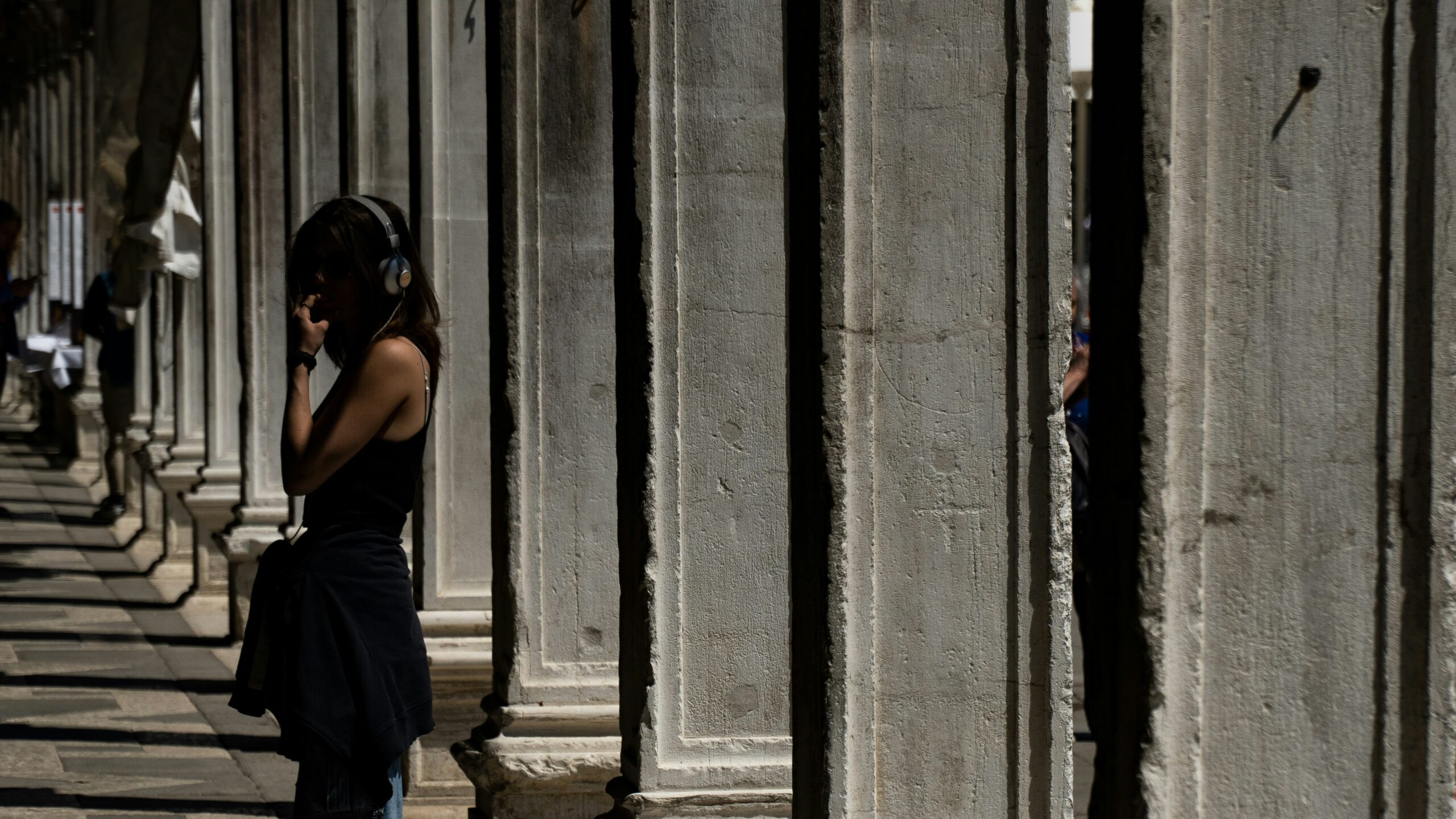
Most people assume silence is best for focused work. Turns out, they’re wrong.
A growing body of research suggests that the right amount of background noise — not silence, not loud music — is what actually supports sustained concentration. And the right amount has a number: around 70 decibels.
What happens to your brain at 70dB
A study published in the Journal of Consumer Research found that a moderate level of ambient noise (~70dB) enhances creative cognition compared to both silence and high noise levels. At this volume, your brain enters a state of “distracted focus” — alert enough to stay on task, but not so stimulated that it’s pulled away from it.
Below 60dB (a quiet room), your mind tends to wander inward. Above 80dB (a loud bar), cognitive load spikes and performance drops. The 70dB range — a busy café, a market street, a courtyard — is where the magic happens.
Harvard Business Review covered this in their breakdown of why you can focus in a coffee shop but not an open office (https://hbr.org/2017/10/why-you-can-focus-in-a-coffee-shop-but-not-in-your-open-office). The difference isn’t just volume — it’s the type of sound.
Why ambient sound beats music for deep work
Music, especially music with lyrics, competes directly with language-processing tasks. If you’re writing, reading, or coding, your brain is trying to parse words on two channels simultaneously. Ambient sound doesn’t do this. It occupies the part of your brain that would otherwise generate distraction, without interfering with the task itself.
The best ambient sounds for deep work share a few traits:
– Consistent, non-rhythmic texture — no beat your brain can lock onto and follow
– Human presence without intelligible speech — the murmur of voices without words
– Natural variation — slight changes over time keep it from becoming grating
The best ambient sound environments for focus
(1) Café interiors
The gold standard. Clinking cups, indistinct conversation, the occasional espresso machine — this combination hits 70dB naturally. It’s why so many remote workers default to coffee shops. You get the sound without the commute at Seventy Decibels (https://seventydecibels.com).
(2) Street markets
Slightly more energetic than a café, but still diffuse. Great for high-output work where you need momentum more than precision. The ambient recording from Hanoi’s streets is a good example of this texture.
(3) Courtyards and plazas
More open, more reverb. Tends to run slightly quieter but with more spatial quality. Works well for reading or light writing.
(4) Train stations and transit hubs
Higher tempo, more directional sound. Better for tasks that benefit from urgency — edits, emails, admin work.
(5) Rain and outdoor ambience
Effective, but different. Rain sits below 70dB and lacks human presence. It reduces anxiety and helps with sleep, but research doesn’t support it for creative output the same way social ambient sound does.
How to use ambient sound effectively
– Start before you need to focus. Put the sound on as you sit down, not after you’ve already been distracted.
– Match the energy to the task. Quiet café for writing, busier street market for fast output work.
– Don’t switch tracks. Changing sounds mid-session triggers attention just like a notification would.
– Keep volume around 65–75dB. If you’re checking your volume meter, you’ll know you’re in range when speech nearby sounds like murmur, not conversation.
The bottom line
Silence isn’t the productivity hack. The right noise is. 70 decibels of ambient sound — calibrated, real, from places that actually feel alive — is one of the simplest environmental changes you can make to your work day.
Pick a place and get to work → (https://seventydecibels.com)